
Will It Blend? Yes. Will It Scale? That Is the Question.
Blendtec turned a $50 lab coat into six million views in a week. Two decades later, every brand on TikTok is still looking for the matches.
In 2006, a blender company in Orem, Utah, spent $50 on a lab coat, a bag of marbles, a rake, a six-pack of soda, a fast-food value meal, and some golf balls (Winters, 2009). The resulting videos pulled six million YouTube views in their first five days (Payne, 2018).
For context, Wright later told a conference audience that a single full-page newspaper ad could cost $83,000 (Esparza, n.d.). Blendtec spent less than that on a lab coat and a rake. Actually, it spent less than that on everything, by a margin of $82,950.
“Will It Blend?” is usually filed under “viral video, lucky break.” That undersells it. It was brand-native entertainment content, built in-house, fronted by the founder, and designed to prove one product claim, years before anyone had a name for that job. Your 2026 creator strategy is trying to do the same thing. It is just paying a lot more for the lab coat.
A quality test with a camera pointed at it
Blendtec was not a household name. It made blenders mostly for commercial customers, and its consumer awareness and sales were low despite a well-regarded product (Payne, 2018). Founder and CEO Tom Dickson already destroyed things for a living: he tested his blenders on unusual materials, such as blocks of wood, as part of quality assurance (Payne, 2018). Wikipedia’s account traces the campaign to an experiment with a box of matches (Will It Blend?, 2026).
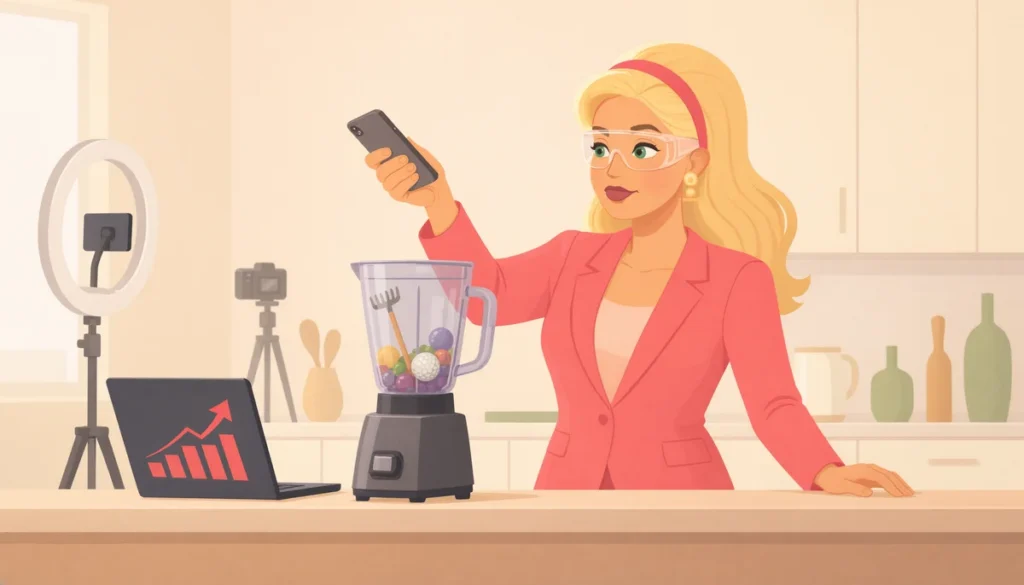
In 2006, the company hired George Wright as marketing director. Wright looked at a man pulverizing lumber for science and saw a show (Payne, 2018; Winters, 2009). The first episodes went up on October 30, 2006 (Will It Blend?, 2026). The format never changed: Dickson, in a lab coat and safety glasses, held up an object, asked the question, pressed a button, and let the result do the talking.
That restraint is the genius. Shannon Stone, founder of Creative Content Studio, pointed out that the idea grew out of testing Blendtec was already doing as the company tried to move from business sales to consumer sales (Payne, 2018). Nobody invented a stunt. They filmed the work.
The product was the punchline
Most “viral” brand content has a problem: you remember the joke and forget the brand. Will It Blend inverted it. The joke was the product claim. Every exploding iPhone was a durability demo. UNSW’s Adrian Payne put it plainly: “You just don’t expect a blender to be this durable” (Payne, 2018).
The editorial calendar wrote itself. Every new Apple launch meant a new device in the jar (Gutelle, 2013). The iPhone became the most popular blend, with more than six million views (Winters, 2009). A Super Bowl episode featured salsa and wings, and a camcorder blended while it was still recording, which the team then tried to return to Best Buy (Will It Blend?, 2026). Best Buy declined. The blender, presumably, had no comment.
Wright’s rules from the conference circuit read like a 2026 creator brief. Content has to be entertaining or worth passing along, and it has to tie to a business objective. Use real people: Dickson was “just being himself.” Treat negative comments as debate, and treat viewers who suggest items as brand ambassadors (Esparza, n.d.). He also offered a line every brand social team should tattoo somewhere visible: “Building a brand is sustainable. Promotions are not” (as cited in Esparza, n.d.).
The joke was the product claim. Every exploding iPhone was a durability demo.
The numbers, and the fine print
By early 2013, the channel had more than 217 million views and 536,000 subscribers (Gutelle, 2013). It won a 2008 Clio Award for viral marketing (Winters, 2009). Dickson went on The Tonight Show and blended a rake handle (Will It Blend?, 2026). The Food Network, which had turned Blendtec down before the campaign, later asked for a blender (Esparza, n.d.).
And then there is the famous figure: a 700% increase in retail sales. You will find it in nearly every case study about the campaign, including this one. Here is the fine print those case studies skip. The number comes from Blendtec itself. When Wright presented it to a room of PR executives in 2008, ClickZ reported that “he didn’t disclose the actual dollar change” (Virzi, 2008). Seven hundred percent of a small number is still a modest number. BYU Magazine says the lift came “within two years” (Winters, 2009). A 2025 case study says “within months” (Novoa, 2025). Neither cites an audited figure.
The show also earned money directly, though not much by today’s standards: about US$15,000 from the video host Revver by September 2007 (Will It Blend?, 2026). The campaign did not need a media budget. It needed a man in a lab coat who was genuinely delighted to destroy things.
It was not forever, either. Dickson stepped down as CEO in 2013 and kept hosting (Gutelle, 2013). The final video went up in 2020, shortly before the company was sold to Wasatch Group (Will It Blend?, 2026). Fourteen years is a remarkable run for a content series. It is also a reminder that even the best ones end.
From the lab coat to the owl
Today, brands spend real money trying to recreate the lab coat. IAB projected U.S. creator economy ad spend would reach $37 billion in 2025, up 26% year over year and growing about four times faster than the overall media industry (Apmann, 2025). Nearly half of ad spenders, 48%, called creators a “must buy” (Apmann, 2025).
The closest modern heir to Will It Blend is not a paid creator, though. It is a brand that became its own creator. In early 2025, Duolingo killed off its owl mascot in a social-led “whodunit” campaign. In its shareholder letter, the company called it “one of our most successful marketing campaigns ever” and said it “spent practically nothing on it,” reporting 1.7 billion organic impressions and “a meaningful lift in new and resurrected users” (Duolingo, 2025). That is Blendtec’s playbook almost exactly: owned channel, a recurring character, a format the audience could join, and a budget that rounds to zero.
The counter-evidence: the blender cuts both ways
Notice what Duolingo did not do: quantify the lift. The same letter is careful to say its A/B testing aims to make “the product itself a durable growth engine” (Duolingo, 2025). Translation: the owl got the attention, and the product had to keep it.
Then the voice that built the audience turned on the brand. In spring 2025, Duolingo published a memo about becoming “AI-first,” and the backlash ran across X, TikTok, and Reddit. Morgan Stanley, using Sensor Tower and other third-party estimates, reported U.S. daily active users fell about 5% in the two weeks after the post. It also reported that average views on Duolingo’s TikTok videos fell about 55% from April to June (Phillips, 2025). Those are analyst estimates, not company figures, and Morgan Stanley kept its buy rating. But the lesson is clear: an audience that loves your brand’s personality will also notice when the company behind it says something unlovable.
Even then, people warned that virality was not a strategy. “Viral videos will have longevity into the future, but you can’t rely on it always working,” Stone said (as cited in Payne, 2018). Craig Gibson of iProspect called it “an art as much as a science” (as cited in Payne, 2018). Blendtec also had something nobody can buy in 2026: an empty YouTube. In 2006, the platform simply had far less content to compete with (Novoa, 2025).
The Maroon Marketing take
Will It Blend worked because it was a product demonstration that happened to be hilarious, not a hilarious video that happened to contain a product. That distinction is the whole game, and most brand-native content gets it backwards.
Before you brief your next creator series, do this:
- Find the test you already run. Blendtec filmed its own quality assurance. Somewhere in your company, someone is already doing the interesting thing. Start there before you hire a writers’ room.
- Make the claim the punchline. If the joke works without your product in the frame, you made an ad for the joke. Every episode should prove one thing your product does.
- Build a format, not a hit. Blendtec had one question and fourteen years of answers. Pick a repeatable structure the audience can predict and contribute to, then let the calendar (product launches, news, Super Bowls) feed it.
- Put a real person in front, and protect them. Dickson worked because he was the actual founder being himself. If your face is a mascot or a creator, remember that the company behind them is still talking every time they post.
- Measure in dollars, not percent. “Seven hundred percent” is a great conference slide. Before you celebrate your own version, write down the baseline, the dollar change, and the time frame. If you cannot, you have a vanity metric with a lab coat on.
The lesson of Will It Blend is not “go viral.” It is “show the thing working.” Everything else is just marbles.
References
- Apmann, T. (2025, November 20). Creator economy ad spend to reach $37 billion in 2025, growing 4x faster than total media industry, according to IAB [Press release]. IAB. https://iab.com/news/creator-economy-ad-spend-to-reach-37-billion-in-2025-growing-4x-faster-than-total-media-industry-according-to-iab
- Duolingo, Inc. (2025). Q1 2025 shareholder letter (Exhibit to Form 8-K). U.S. Securities and Exchange Commission. https://www.sec.gov/Archives/edgar/data/1562088/000156208825000098/q1fy25duolingo3-31x25share.htm
- Esparza, S. (n.d.). PubCon keynote: George Wright of Blendtec. Bruce Clay. https://www.bruceclay.com/?p=11455
- Gutelle, S. (2013, February 21). It will end: Blendtec CEO and “Will It Blend?” host steps down. Tubefilter. https://www.tubefilter.com/2013/02/21/will-it-blend-tom-dickson/
- Novoa, S. (2025, March 9). Will it blend? How a blender brand became a viral marketing sensation. Science of Retail. https://scienceofretail.com/blendtec-will-it-blend-viral-marketing-case-study/
- Payne, A. (2018, July 18). How Blendtec’s marketing campaign smashed the secret of going viral. UNSW BusinessThink. https://www.businessthink.unsw.edu.au/articles/blendtec-marketing-campaign
- Phillips, M. (2025, July 8). Backlash to Duolingo’s AI memo will hit Q2 numbers: Morgan Stanley. Sherwood News. https://sherwood.news/markets/backlash-to-duolingos-ai-memo-will-hit-q2-numbers-morgan-stanley/
- Virzi, A. M. (2008, September 12). Mashup: 200 PR execs, one blender. ClickZ. https://clickz.com/mashup-200-pr-execs-one-blender/86409/
- Will It Blend? (2026). In Wikipedia. https://en.wikipedia.org/wiki/Will_It_Blend%3F
- Winters, C. R. (2009). Will it blend? Y Magazine (Brigham Young University). https://magazine.byu.edu/article/will-it-blend/