
The Marlboro Man and the Myth of Authenticity
Philip Morris hired real cowboys to sell a fictional one. Your creator brief is doing the same thing with better lighting.
In 1999, Advertising Age ranked the greatest advertising icons of the 20th century. Ronald McDonald came second. The Jolly Green Giant came third. First place went to a man on a horse who did not exist, selling a product that killed several of the men who played him (Elliott, 1999).
The Marlboro Man is usually taught as a masterclass in brand repositioning, and it is one. It is also the most useful case study we have for a word marketers now say several times a day: authentic. The campaign took off once Leo Burnett stopped using models and hired actual cowboys. The performers were real. The thing they were selling was made up.
Your 2026 creator strategy is built on the same split.
Mild as May
Before the cowboy, Marlboro was a women’s cigarette. Philip Morris launched it in 1924 with the slogan “Mild as May” (Marlboro Man, 2026). Its ads promised, “Ivory Tips to protect the lips” and “red beauty tips to match your lips and fingertips” (Stanford Research into the Impact of Tobacco Advertising [SRITA], n.d.). By the early 1950s, it held less than 1% of the market (VanHooker, 2019).
Then filters became the industry’s answer to health fears, and filters read as feminine. Men worried a filtered cigarette was, in the era’s words, a little “sissy” (SRITA, n.d.). Competitors leaned into health claims. Burnett never mentioned the filter’s safety at all and surrounded it with the most aggressively masculine people he could find (Marlboro Man, 2026).
The first wave in 1954 and 1955 was a casting call of manly professions: sea captains, weightlifters, war correspondents, construction workers. Many had a military-style tattoo on the hand (Marlboro Man, 2026; SRITA, n.d.). Smithsonian historian Scott Ellsworth summed up what happened next: “whenever they showed a cowboy, there was a little rise in sales” (as cited in VanHooker, 2019). So they kept the cowboy and retired the weightlifter. Marketing has always been A/B testing. It just used to take longer.
Real cowboys, fake country
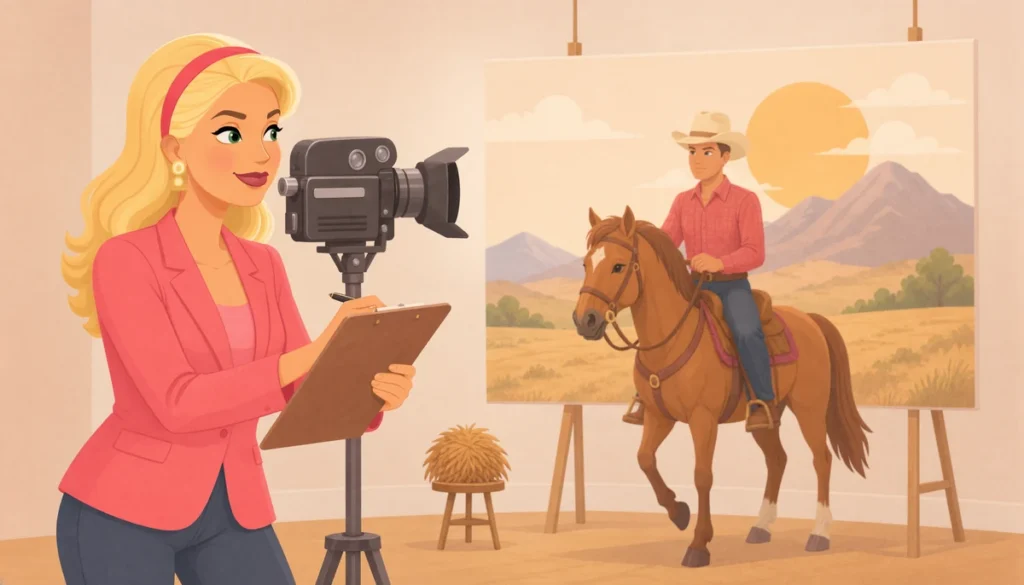
Here is the part that matters for us. Early Marlboro commercials used paid models and, in some cases, agency employees in hats. Burnett found them inauthentic (Marlboro Man, 2026). So in 1963 the campaign was rebuilt around working cowboys and stuntmen, with Elmer Bernstein’s theme from The Magnificent Seven underneath (Marlboro Man, 2026).
The agency went scouting where cowboys actually were. Brad Johnson, who appeared in the ads in 1987, described the process: “They’d go to a rodeo or a livestock auction and try to find guys who had the right look, but were also experienced cowboys” (as cited in VanHooker, 2019). Johnson was paid $3,800 a day (VanHooker, 2019), a very good rate for standing near a horse.
The most famous find was Darrell Winfield, discovered in 1968 on a ranch outside Riverton, Wyoming. A Leo Burnett creative director remembered the moment: “I had seen cowboys, but I had never seen one that just really, like, he sort of scared the hell out of me” (as cited in VanHooker, 2019). Winfield wore no makeup on shoots (Rossi, 2025) and held the role until 1989, appearing in more than eight in ten Marlboro ads at his peak (VanHooker, 2019). Robert Norris, a rancher who did twelve years in the role, never smoked (Marlboro Man, 2026).
Every detail you could verify was true. The calluses were real. The horse had a real opinion of you. And the ad as a whole was a fiction: a cigarette as a badge of rugged independence and good health, sold by men chosen because they looked like they could not possibly be harmed by it. Stanford’s tobacco advertising archive describes the effect of fearless figures in cigarette ads plainly: “Smoking is a very public badge of their fearlessness and willingness to face danger with indifference because they are immune to such anxieties” (SRITA, n.d.).
It worked. After the 1963 rebuild, Marlboro reached the top of the tobacco industry by 1972 (Marlboro Man, 2026).
Every detail you could verify was true. And the ad as a whole was a fiction.
The bill
At least five men who appeared in Marlboro advertising died of smoking-related illness, which is how Marlboro Reds earned the nickname “cowboy killers” (Marlboro Man, 2026).
Wayne McLaren, who had modelled for Marlboro, became an anti-smoking campaigner after his lung cancer diagnosis and died in 1992 at 51. “I’ve spent the last month of my life in an incubator, and I’m telling you, it’s just not worth it,” he said (as cited in VanHooker, 2019). Philip Morris first denied he had appeared in its ads, then argued he was not the Marlboro Man (Marlboro Man, 2026). Eric Lawson, who appeared in print ads from 1978 to 1981, died of COPD in 2014. His wife Susan said: “He knew the cigarettes had a hold on him…He knew, yet he still couldn’t stop” (as cited in VanHooker, 2019).
When Ad Age crowned the Marlboro Man in 1999, William Novelli of the National Center for Tobacco-Free Kids conceded the obvious: “No one can dispute that the Marlboro Man is a brilliant creation and a powerful icon.” Then he asked the better question: what harm has it done? (as cited in Elliott, 1999).
Authenticity is a casting decision
Fast forward to the creator economy, where “authentic” is the most popular word in any brief that also contains a script.
In IZEA’s 2025 trust survey of more than 1,000 American consumers, 77% said they favour influencer-created content over professionally scripted ads (IZEA, 2026). Worth noting: IZEA runs an influencer marketing platform, so this is a vendor reporting that people like the thing the vendor sells. It may still be true. Burnett’s sales data also said people liked cowboys.
But look at what that preference actually rewards. Not truth. Texture: natural light, a kitchen counter, someone talking to their phone. That is a look, and looks can be cast. An entire category of paid “UGC creators” now exists to produce content that appears unpaid. Burnett went to rodeos. We go to marketplaces.
And then there is the logical endpoint. In June 2024, TikTok announced Symphony Digital Avatars, including stock avatars “created using paid actors that are licensed for commercial use,” pitched as a way to “breathe life into branded content with generative AI avatars of real people” (TikTok, 2024). A modern brand can license the cowboy’s face once and have him say anything, in thirty languages, forever. It is the Marlboro Man without the inconvenient part where the actor eventually tells a newspaper the truth.
The counter-evidence: authenticity is not dead; it just moved
A 2025 Journal of Marketing study by Duffek, Eisingerich, Merlo, and Lee interviewed consumers, influencers, brand managers, and agencies and found that each group defines influencer authenticity differently, and that those misalignments break partnerships (Duffek et al., 2025). As summarized by the American Marketing Association, one of the more interesting findings cuts against the instinct to hide the deal: “Transparent admissions of financial motivations, especially when delivered with humour or creativity, can enhance influencer authenticity” (Duffek et al., 2026).
That is the opposite of the Marlboro playbook. Burnett’s authenticity depended on the audience never thinking about the money. Modern audiences may reward a creator who says the quiet part out loud. The cowboy never once turned to camera and said, “Philip Morris is paying me $3,800 today, and honestly, the horse is the talent here.”
Authenticity of the messenger and truth of the message are separate things. The Marlboro Man proves you can max out the first and ignore the second.
The Maroon Marketing take
The Marlboro Man did not fail because he was inauthentic. He failed, morally if not commercially, because the claim underneath him was false, and no amount of real dust on real boots could fix that.
If your brand is spending on “authentic” creator content in 2026, here is what to actually do:
- Audit the claim before you cast the face. Write down in one sentence what the content implies about your product. If that sentence would embarrass you in a regulator’s inbox, a more relatable creator will not save it.
- Stop scripting for texture. If the brief specifies the kitchen, the lighting and the “spontaneous” reaction, you are not buying a creator; you are buying a costume. Give an outcome and let them get there.
- Make the money visible, on purpose. The research says disclosure delivered with some personality can raise trust. Treat the disclosure as part of the creative, not the legal footer.
- Set a rule for synthetic people now. If you use AI avatars of licensed actors, decide whether you will label them before someone else decides for you. “A real person, saying words a real person never said” is a sentence you do not want in a headline.
- Ask Novelli’s question. Every campaign review should end with “what harm could this do if it works?” Usually the answer is none. The Marlboro Man is what happens when nobody asks.
Authenticity is a casting choice. Honesty is a strategy. Only one of them ages well.
References
- Duffek, B., Eisingerich, A. B., Merlo, O., & Lee, G. (2025). Authenticity in influencer marketing: How can influencers and brands work together to build and maintain influencer authenticity? Journal of Marketing, 89(5), 21-46. https://doi.org/10.1177/00222429251319786
- Duffek, B., Eisingerich, A. B., Merlo, O., & Lee, G. (2026, August 4). 90% of consumers distrust influencers. How can marketers rebuild influencer authenticity? American Marketing Association. https://www.ama.org/2026/08/04/90-of-consumers-distrust-influencers-how-can-marketers-rebuild-influencer-authenticity/
- Elliott, S. (1999, May 2). Ad Age touts icons of the century. Deseret News (New York Times News Service). https://www.deseret.com/1999/5/2/19443130/ad-age-touts-icons-of-the-century/
- IZEA. (2026). 2025 trust in influencer marketing. https://izea.com/resources/insights/2025-trust-in-influencer-marketing/
- Marlboro Man. (2026). In Wikipedia. https://en.wikipedia.org/wiki/Marlboro_Man
- Rossi, A. (2025, October 25). How Wyoming’s “Marlboro Men” helped get the world hooked on cigarettes. Cowboy State Daily. https://cowboystatedaily.com/2025/10/25/how-wyomings-marlboro-men-helped-get-the-world-hooked-on-cigarettes/
- Stanford Research into the Impact of Tobacco Advertising. (n.d.). Marlboro men. Stanford University. https://tobacco.stanford.edu/cigarettes/filter-safety-myths/marlboro-men/
- TikTok. (2024, June 17). Meet Symphony Avatars: TikTok’s new creative AI tool. https://newsroom.tiktok.com/en-us/announcing-symphony-avatars
- VanHooker, B. (2019, November 5). An unfiltered oral history of the Marlboro Man. MEL Magazine. https://melmagazine.com/en-us/story/an-unfiltered-oral-history-of-the-marlboro-man