

From The Furrow to the Feed:
What John Deere’s 1895 Magazine Teaches Us About Content Marketing Today
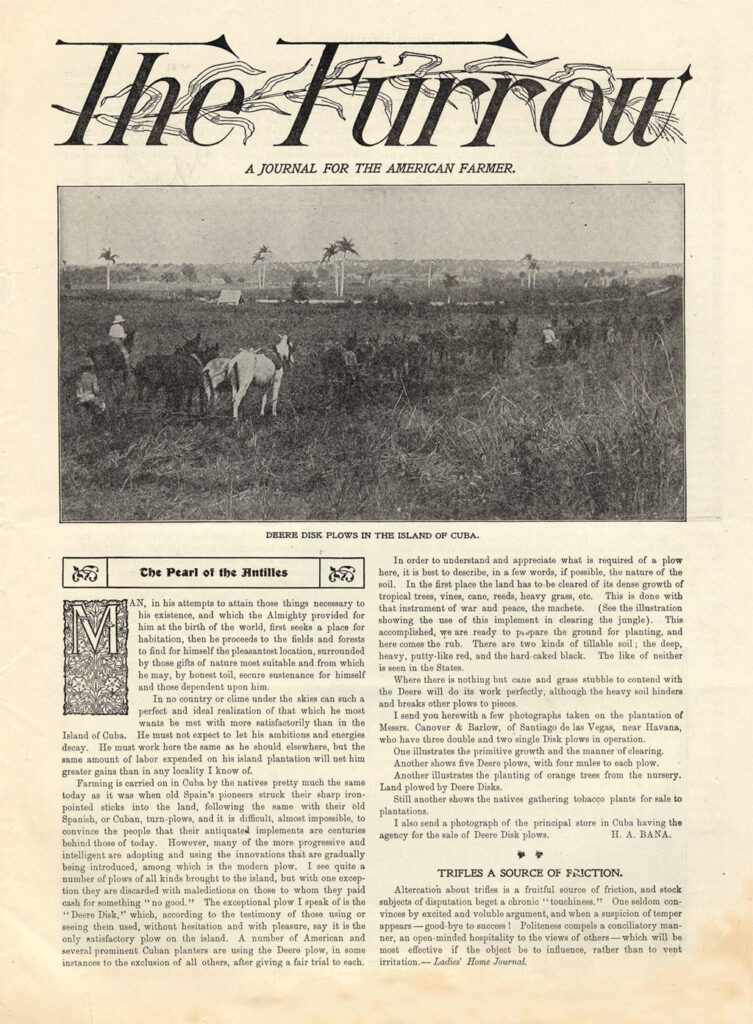
In 1895, a farm equipment company in Illinois did something no brand had really done before. They launched a magazine. It wasn’t a catalogue or a product brochure. It was a magazine filled with journalism, photography, farming advice, and business insights, and it deliberately avoided talking about the company behind it.
It was called The Furrow and published by John Deere.
That first issue is lost. Even John Deere’s own archives in Moline, Illinois, don’t have a copy. David Jones, the magazine’s 14th editor and current publications manager, jokes that if one ever turned up, it would be worth a pretty penny.
What hasn’t been lost is everything The Furrow built over the past 130 years. At its peak in 1912, the magazine reached more than 4 million readers. Today, it still reaches about 570,000 in the U.S. and Canada and around 2 million globally, distributed through the same network of John Deere dealers that distributed the original edition. It is published in multiple languages, available in both print and digital, and remains, by almost every account, the longest-running content marketing program in history.
The real question in 2026, when every brand is trying to build a newsletter, a podcast, or a YouTube channel, isn’t just how The Furrow lasted so long. It’s what made it work in the first place, and whether any of that can actually be repeated today.
The Problem Before the Product
To understand why The Furrow worked, you have to understand the specific gap it was trying to fill.
In the 1890s, American farmers faced rapid technological change and had very little support. There were new agricultural methods, new equipment, and new market forces, but no reliable, unbiased source of information to help them make sense of it all. The existing options were either promotional material from equipment companies, which was obviously biased, or academic publications that were too technical to be useful.
Charles Deere, the founder’s son and the man running the company at the time, spotted the gap. His instinct wasn’t primarily about selling more equipment. It was about building something farmers would actually find valuable enough to read.
John Deere’s manager of corporate history, Neil Dahlstrom, has described how the publication changed over time. It started as a mix of advertorial content and reprinted farming tips, more like a Farmers’ Almanac than a magazine, and then became much more editorially serious. The mission evolved along with it.
“Telling stories that folks enjoy reading — and that they can use in their own operations — has been the recipe since the beginning.” – David Jones, Publications Manager, The Furrow.
What stands out is what was left out from the beginning. John Deere’s name was on the masthead, and their equipment was sometimes featured, but the editorial content wasn’t about John Deere. It focused on farming techniques, business strategy, crop science, and community stories. The company acted as a sponsor, not the subject.
This was a radical editorial stance in 1895. It remains relatively rare today.
The Mechanics of 130 Years of Reader Loyalty
It’s easy to see The Furrow’s long run as a feel-good story about authentic brand values. But there are specific operational and editorial choices that explain why readers kept returning, and why the magazine outlasted almost every other brand publishing experiment of the 20th century.
Editorial independence was non-negotiable
The most important structural decision John Deere made was to separate the magazine’s editorial voice from corporate messaging and to defend that separation for over a century. According to Jones, anyone looking through 50 years of back issues would find the words “John Deere” in the editorial pages only a handful of times per issue.
This matters because it’s the hardest thing for most brands to do. Every marketing department eventually wants the content to talk about the product. Every executive sponsor eventually asks why the company’s name isn’t featured more prominently. The Furrow’s team spent a century convincing management to leave the editorial space alone, and that discipline is the main reason the content stayed credible.
The content was produced by people who understood the audience from the inside
Longtime art director Tom Sizemore, who spent 37 years working on the publication, described the team’s editorial philosophy simply: even the most technical subject needs a human story behind it. That approach requires people who understand farming well enough to find those stories, not generalist content producers brought in from outside the industry.
John Deere staffed The Furrow with people who had real agricultural expertise. Many had degrees in agricultural economics or engineering. Some were the sons and daughters of farmers. The result was a publication that felt like it came from within the farming community, not from a marketing department on the outside.
Investment went up, not down, as the magazine proved itself
In 1912, the year The Furrow reached its peak circulation of 4 million readers, John Deere did not cut the budget. Instead, they bought their first electric printing press, a machine that printed in two colours and produced 50,000 copies in eight hours, at a cost equal to about $850,000 in 2013 dollars.
That decision shows something important about how the company saw the magazine. It wasn’t just a marketing expense to be cut when times were tough. It was infrastructure, and infrastructure needs investment.
The format evolved, but the mission didn’t
The Furrow started as a large-format 10-by-13-inch newspaper, delivered quarterly through the new Rural Free Delivery system of the U.S. Postal Service, and targeted at 17 different regional markets. Over the decades, it became smaller, thicker, and more visually focused. Full-colour photography was added in 1958. Digital editions came much later.
But through all those changes, the editorial mission stayed the same: help farmers run better businesses and live better lives. The format changed to fit the audience, but the purpose stayed the same.
What the Readership Data Actually Tells You
The Furrow’s circulation figures tell an interesting story, but the more revealing number is the depth of engagement, not reach.
Surveys of The Furrow’s readers have consistently found that about 80% still prefer the print edition to the digital edition, no matter age. In a time when print is supposedly dying, a brand magazine still has 80% of its readership preferring print. That’s not nostalgia. That’s utility; readers are choosing the format that works best for their reading style.
Even more striking, surveys have found that 40% of readers read every single word of every issue, including the ads. For comparison, average email open rates for branded newsletters are around 20-25%, and these only measure those who opened the email, not those who re-read the message.
The publication generates about 25 million impressions per year across its global readership. But what really sets The Furrow apart is the quality of those impressions, the trust, attention, and engagement behind them, not just the volume.
| What 40% full-readership actually means If your brand content had a 40% full-read rate, it would be considered an extraordinary success. Most brand content measures itself on reach and clicks. The Furrow’s team has always measured itself on whether farmers found the content genuinely useful. Those are different optimization targets, and they produce very different outputs. |
Going Digital Without Losing the Plot
One of the most instructive parts of The Furrow’s history is how it handled the move to digital media, a shift that ended most other legacy print publications.
The Furrow didn’t drop print when the internet arrived. Instead, it expanded into digital. Both formats are still active. The magazine is available on deere.com, with current and archived issues, and digital distribution has allowed The Furrow to reach a truly global audience. It now publishes in multiple languages and reaches farmers across four continents.
The key to that transition was that John Deere never confused the medium with the mission. The Furrow wasn’t just a print magazine with good content. Its mission was to help farmers succeed, and print was simply the way to deliver that. When new ways to deliver content appeared, the mission stayed the same. Only the channels changed.
That discipline is harder than it sounds. Most brands that launch content programs define themselves by the format: we have a podcast, a newsletter, or a YouTube channel. When the format loses relevance, the program loses its purpose. The Furrow’s reason for existing came before any specific format, and that’s why it survived every format shift over the last 130 years.
What This Actually Means for Brands Building Content in 2026
The Furrow isn’t just a case study in nostalgia. It’s a case study in the specific conditions that let brand content build real trust over time. Those conditions are worth naming clearly: to help the audience, not to sell to them. This sounds obvious. It is almost never actually practiced. When you read The Furrow, you are reading about farming. You are not reading about John Deere equipment. Most brands cannot hold that line.
- Editorial credibility is protected by structural independence. The content team has to have the authority to say no to corporate messaging. Without that structural protection, marketing pressure gradually turns editorial content into advertising, and readers leave.
- The people creating the content truly understand the audience, not just as a demographic, but from real experience. Generic content teams produce generic content. The Furrow was made by people who cared about farming. treats content as infrastructure, not as a campaign. The Furrow isn’t funded on a campaign-by-campaign basis. It’s a standing commitment that has run continuously since 1895, with the investment increasing when performance warranted it.
- The mission is not tied to any format. The Furrow survived the decline of newspapers, the rise of magazines, the advent of the internet, and the shift to mobile. It survived all of these changes because it was never defined by a format, but by its purpose.
The hard truth is that most brand content programs fail not because the content is bad, but because the organization around the content is flawed. The budget is for campaigns, not for infrastructure. The editorial voice is controlled by marketing, not by editors. The team lacks real subject-matter expertise. And as soon as the metrics disappoint, the program is cut.
John Deere never cut The Furrow. They bought a working printing press in 1912. That’s the decision that built 130 years of trust.
The Question to Take Into Your Week
David Jones has described The Furrow as a portal into a brand that people feel passionately about, to the point that kids wallpaper their bedrooms with John Deere tractors. That level of brand passion doesn’t come from advertising. It comes from decades of being genuinely useful to the people you serve.
Most brands want that kind of relationship with their audience. Very few are willing to build the kind of content program that earns it.
The Furrow didn’t build that relationship by talking about John Deere. It was built by talking about farmers, their problems, their communities, their innovations, and their lives.
Here’s the question worth sitting with before you brief your next piece of content:
- If your company’s name disappeared from this piece of content, would readers still want it?
If the answer is yes, you’re building something real. If the answer is no, you’re just running advertising in a different format.
The Furrow has been answering yes to that question for 130 years. That’s the whole case study.
Three Things to Do Differently This Week
- Read an issue of The Furrow. It’s free at deere.com. Read it as a marketer, not as a farmer. Pay attention to how many times John Deere’s equipment is mentioned in the editorial pages. You’ll be surprised.
- Audit your last five pieces of brand content against one question: would a reader share this with someone who’s not already your customer? If the answer is no for all five, your content is marketing, not media.
- Find the version of this in your own industry. Every sector has a publication or resource that people in that field genuinely trust. Study what it does that your brand’s content doesn’t. That gap is your brief.
Sources
• Content Marketing Institute — The Story of Content: Rise of the New Marketing (Documentary)
• John Deere — The Furrow: Official Publication Page (current issues & archive)
• Medium / David Cross — The Furrow: John Deere’s Enduring Journey in Content Marketing (2023)